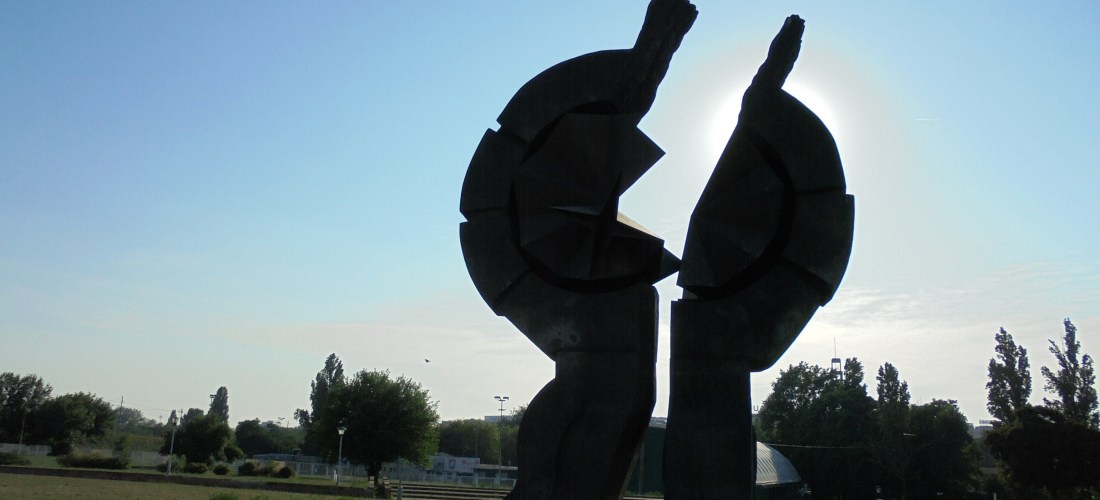
Monuments dedicated to the Peoples’ Liberation Struggle and the major ideals, purposes and values of Socialist Yugoslavia (internationalism, anti-imperialism, friendship and unity among the different peoples and nationalities) in the period between 1945 to 1991 were erected throughout Yugoslavia in the form of figurative artworks, architectural buildings, memorial mausoleums, sculptures and monumental sculptures, memorial busts and plaques, memorial buildings and cemeteries, etc. According to incomplete data, around 15,000 monuments to the Liberation were erected in the Socialist Federal Republic of Yugoslavia, and many of these were demolished or damaged during the disintegration of SFRY in the Nineties. It has not only been a revisionist attempt against the Liberation struggle and its values but also a heavy loss in memorial and cultural heritage.

Link to Yugoslavia Spomenik Map via ScribbleMaps
During the first decade after the Second World War, many monuments dedicated to heroes, fallen partisans and victims of fascism were made in the traditional style of Socialist realism, with its features of clearness, representation of the figures in a realistic mode, to represent the revolution and the fight for emancipation, based on the model of the monuments in the Soviet Union. After the 1948 Resolution and the split between the two leaders, Tito and Stalin, efforts were made to characterize, autonomize, and differentiate Yugoslavia from the Soviet Union, also in the realization of artworks, monuments and memorials dedicated to the WWII. As a result, numerous monuments dedicated to the People’s Liberation Struggle and the victims of fascism were designed in the style of geometric abstraction, symbolic abstraction and minimalism. In the period between the second half of the 1950s and the first half of the 1980s the main form was the Socialist modernism, which alternated stylized, geometric, abstract forms and strong symbolism.

Link to Dzamonja’s Spomenik Map via ScribbleMaps
During the war of the Nineties, many monuments to the National Liberation Struggle were destroyed or removed. Over 3,000 memorials were destroyed in Croatia (740 monuments, busts and memorial plaques), and among them: the “Victory of the People of Slavonia” monument in Kamenska, work of sculptor Vojin Bakić, demolished in 1992; the Monument to the national hero Stevan Filipović in Opuzen, work of Miro Vuč, demolished in 1991; the monument “We will not take what belongs to others – We will not give what belongs to us” on Vis, work of Antun Augustinčić, removed in 1994. In Bosnia and Herzegovina, various monuments were demolished: the Monument “To the Fallen Soldiers” in Livno, work of Antun Augustinčić, demolished in 1992; “To the Fallen Soldiers” in Makljen, Prozor, work of Boško Kućanski, demolished in 2000. In Kosovo, among the demolished monuments, the great Monuments to “Brotherhood and Unity“, by Lojze Dolinar, in Djakovica (expunged 1999) and by Miodrag Pecić and Svetomir Basara, in Landovica (expunged 1999).

Link to Zivkovic’s Spomenik Map via ScribbleMaps
Recovering such cultural and memory heritages is fundamental for peace, strengthening dialogue and mutual understanding, supporting peacebuilding and promoting coexistence.
 civilpeacecorpskosovo