
Mitrovica is one of the most complex places in Kosovo and the region, and was also, in the past, one of the most multi-ethnic areas in the entire former Yugoslavia, on that time with 60% Albanians and 40% mostly Serbs, and, inside such 40%, something like 30% Serbs and something like 10% different communities, as Bosniaks and Roma, Ashkali and Egyptians, Gorani and Turks. Even if the ethnic balance changed from time to time, in the Socialist period the city was shaped by multi-ethnic tolerance, reciprocity and coexistence.
Before the 1999 Kosovo war and in former Yugoslavia socialist system, the region had both economical and social relevance, thanks to the presence of the Trepça Mines, which employed over thousands workers, and also social welfare and people’s power as well, since it had very broad diversity, in terms of value and culture. Whenever you have diversity, you have social life and cultural richness, values and ownership in a positive way. So, being in the middle, you can usually get your pragmatic view to address issues.
After the war, Mitrovica is one of the poorest cities in Kosovo and the Balkans, and this contradiction between the past and the present, the history of opportunities and coexistence and the present of difficulties and division, is now a major feature and a relevant shortcoming for Mitrovica itself, having been, before the war, the most industrialized city in the region, with a rich economic, social and cultural environment, sport facilities and cultural scene (it used to be addressed as the “Rock City”) while now, after the war, it is one of the poorest cities in the area, with lots of problems and various misfunctions, (social and cultural) divisions, (concrete and psychological) barricades.
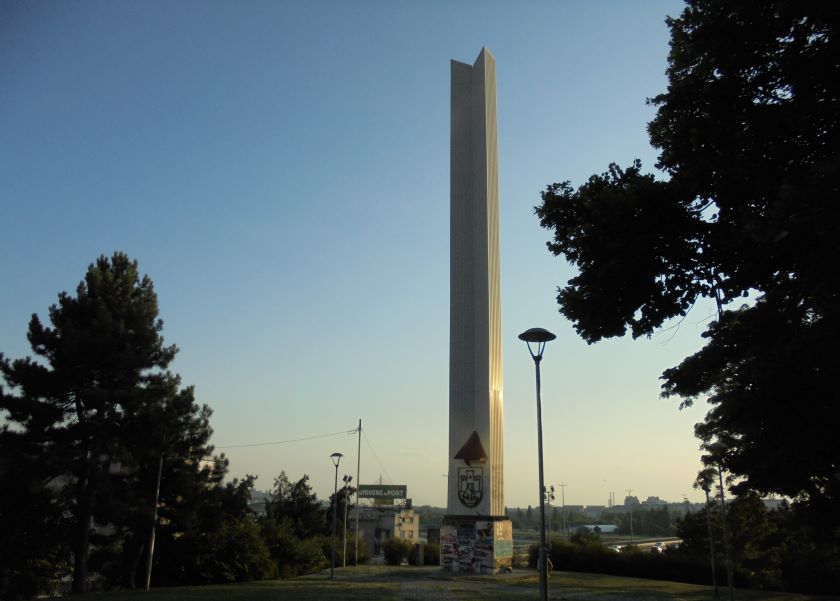 Obelisk dedicated to the Non Aligned Movement, Belgrade
As a consequence, this is also the place in the region (and one of the places in the Balkans) with the highest number of unemployed young people, mostly 60% of young people. For all those reasons, Mitrovica today represents a wound of conflict which is still “frozen” and “freezing” the society, because anyone is settled in his own way, mood and home; maybe, the rest of Kosovo is settled in diverse ways and going to develop time by time, but Mitrovica is a place where «time seems stopped». This is the meaning of Mitrovica, and you can feel time seems not passing and everything seems not going to change in any way.
Earlier, Mitrovica was recognized for many different reasons, such as industry, museums, cinema, sports and rock scene, and it was like the first place in Kosovo to have a Sport centre, such as the “Minatori Sport Center”, where K.B. Trepça used to play, and one of the most active musical stage and Rock scene in the entire Yugoslavia, and those were a salient part of the everyday life in the city. Historically, Mitrovica is rich in traditions and cultures and hosts one of the most important archaeological sites of the region, one of the most important of the whole Balkans. From all those things, coming from the “memory of the past”, the city has a huge potential for cultural development and social inclusion.
 civilpeacecorpskosovo