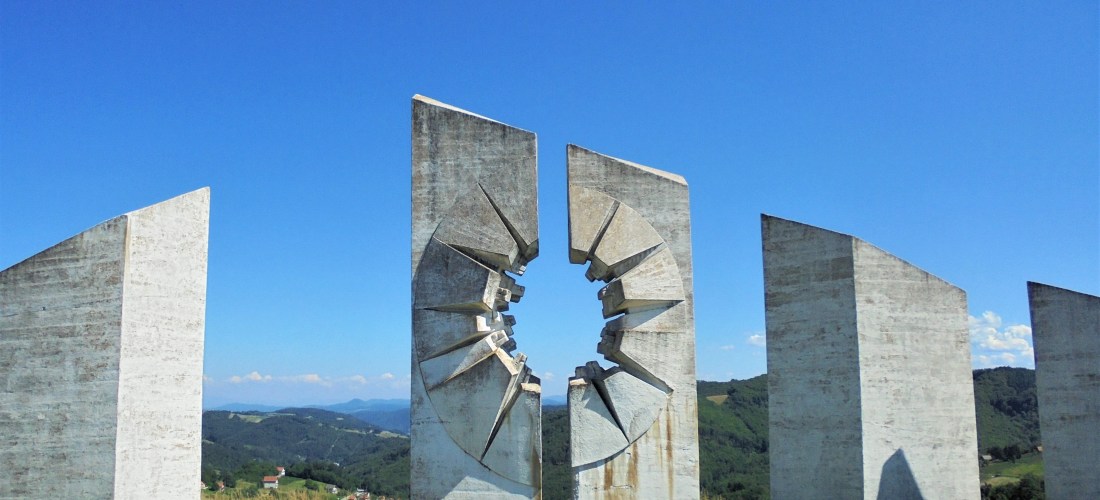
Bogdan Bogdanović (Belgrade, August 20, 1922 – Vienna, June 18, 2010) was a Yugoslav architect, sculptor, philosopher, university professor (professor at the University of Belgrade), and politician (mayor of Belgrade from 1982 to 1986). In short, in relation to the aesthetic reflection and artistic production of socialist Yugoslavia, he was one of the most iconic figures and one of the most important architects of the so-called “monumental sculpture in open spaces”, which gave us vibrant examples of art for peace and unforgettable masterpieces of socialist modernism. He succeeded in combining, in a singular and fascinating union, the rationality, essentiality, and formal balance typical of modernism with the principles of self-management, emancipation, positive peace, social justice, brotherhood, and unity among peoples, typical of Yugoslav socialism.
Bogdan Bogdanović’s presence in the Yugoslav aesthetics is significant in architecture and sculpture. As has been said, he brought “architecture into sculpture”, replacing the prevailing traditional figurative style (regarding, for example, the fascinating, powerful, ritualistic canon of socialist realism) with monuments that emerge from historical memory and the landscape, representing an architectural whole with the environment, and the social and territorial context in which they are inserted. The aesthetic quality of his works is abstract, symbolic, evocative, allusive, and, above all, universal, both for their retroactive cultural references (e.g. to East cultures) and for the “absolute form” they evoke.
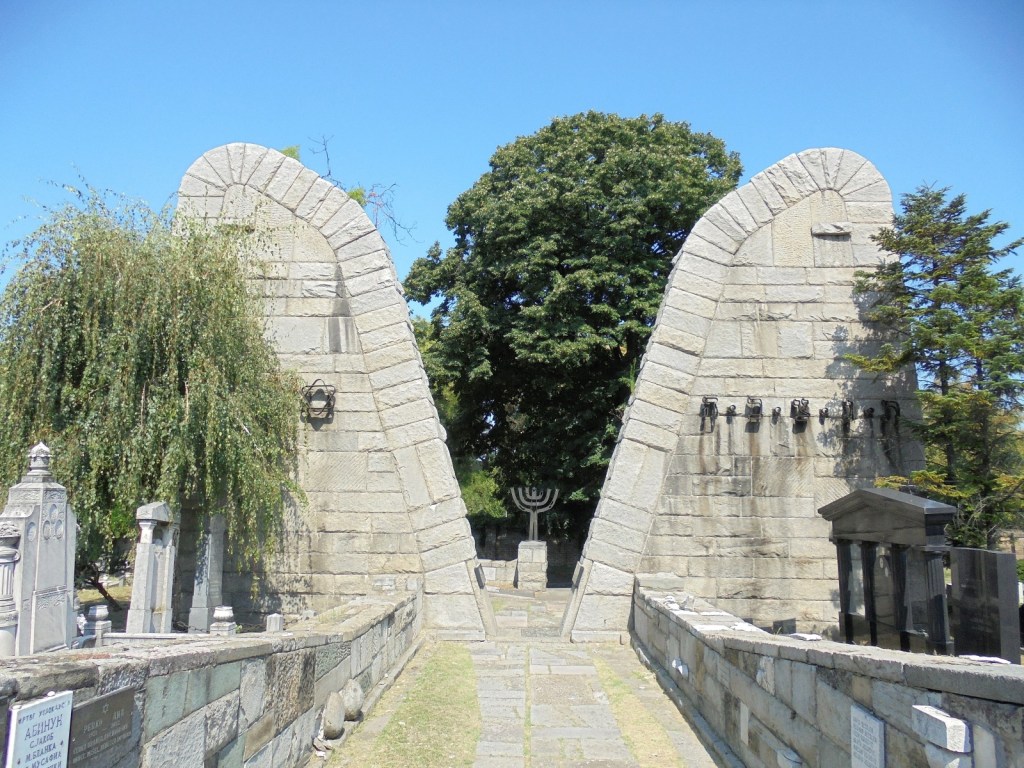
The Memorial to the Jewish Victims of Fascism, Belgrade, 1952
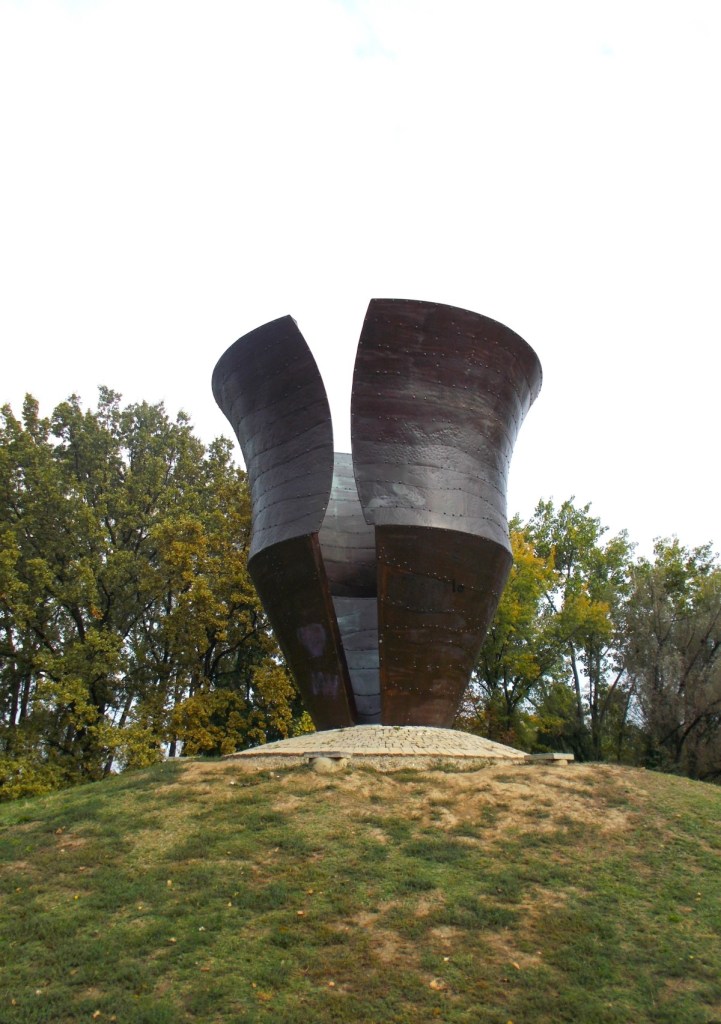
The Memorial Necropolis to the Victims of Fascism, Sremska Mitrovica, 1960
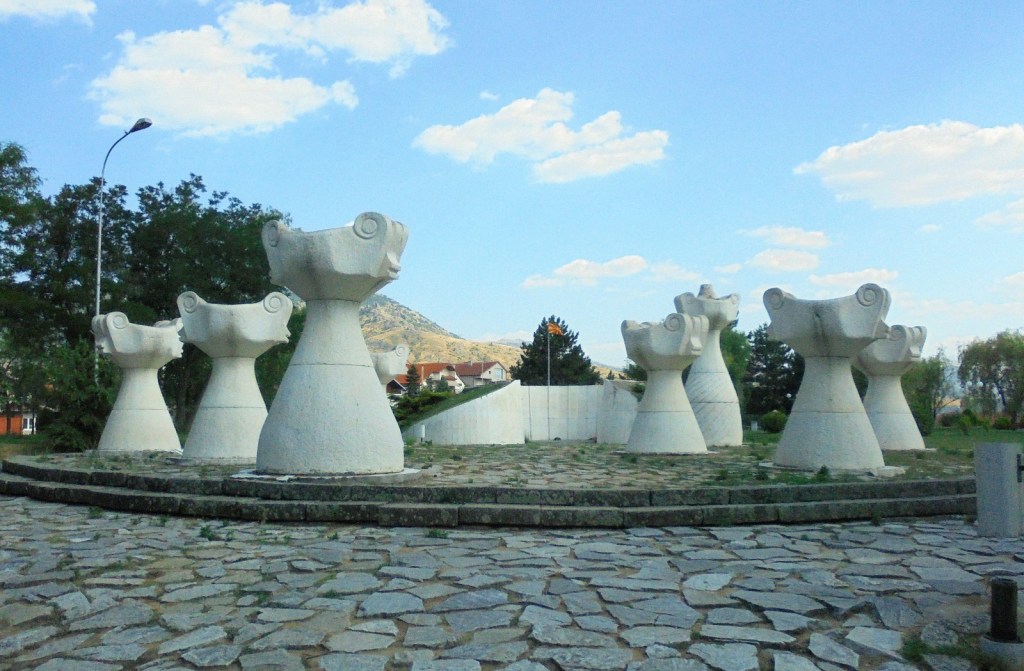
The Partisan Necropolis (Mound of the Unbeaten), Prilep, 1961
His reflections about the “space of the city” are highly significant, characterized by a highly symbolic vision of “interior architecture” and “human architecture”. His contribution lies at the crossroads of aesthetics, architecture, sculpture, urbanism, and mythology. His 1966 essay “Urbanističke mitologeme” (Urbanistic Mythologemes) is crucial in this regard. The term “mythologeme” specifically refers to the original core of the myth, the underlying theme or basic model from which the mythical narrative or mythical tale develops.
In other words, alluding to Kerényi’s theory, it is the minimal recognizable element of a complex of mythical material that is continually revisited, reconfigured, and reorganized, yet which nevertheless, in its essence, remains the same fundamental story. It is the basic idea or image that a culture develops into a narrative, and at the same time, in Bogdan Bogdanović’s aesthetics, it is the fundamental narrative theme, the aesthetic and symbolic core that, variously reshaped, characterizes and animates his works.
His urban mythologies, therefore, move along three coordinates: the idea of the city’s space as a space of mythical construction, “the city as myth”, in the sense that human settlement arises from an act of ritual foundation, tied to archaic cosmologies and inspired by forms of collective memory; then, spatial archetypes, linked to primary figures and cosmological symbols that recur in the construction of cities and monuments and which, as we will see, inspire much of the symbolism and form of his monuments and his most mature works.
Finally, the inseparable connection between construction and landscape: urban planning is conceived as a profound dialogue (aesthetic-magical-ritual) between the human sign and nature, and the monument is in turn built in relation to and in function with the surrounding landscape, with which it forms a whole and which in turn becomes a constitutive part of the monumental construction (aesthetic experience).
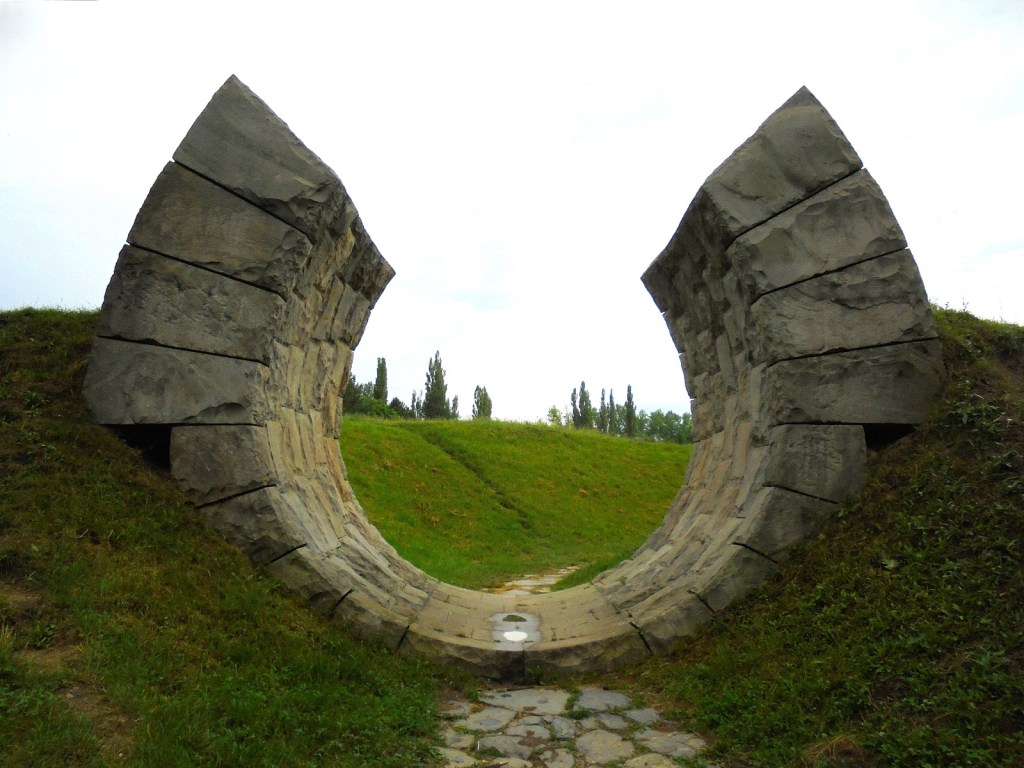
The Symbolic Necropolis of Slobodište (Kruševac), 1961
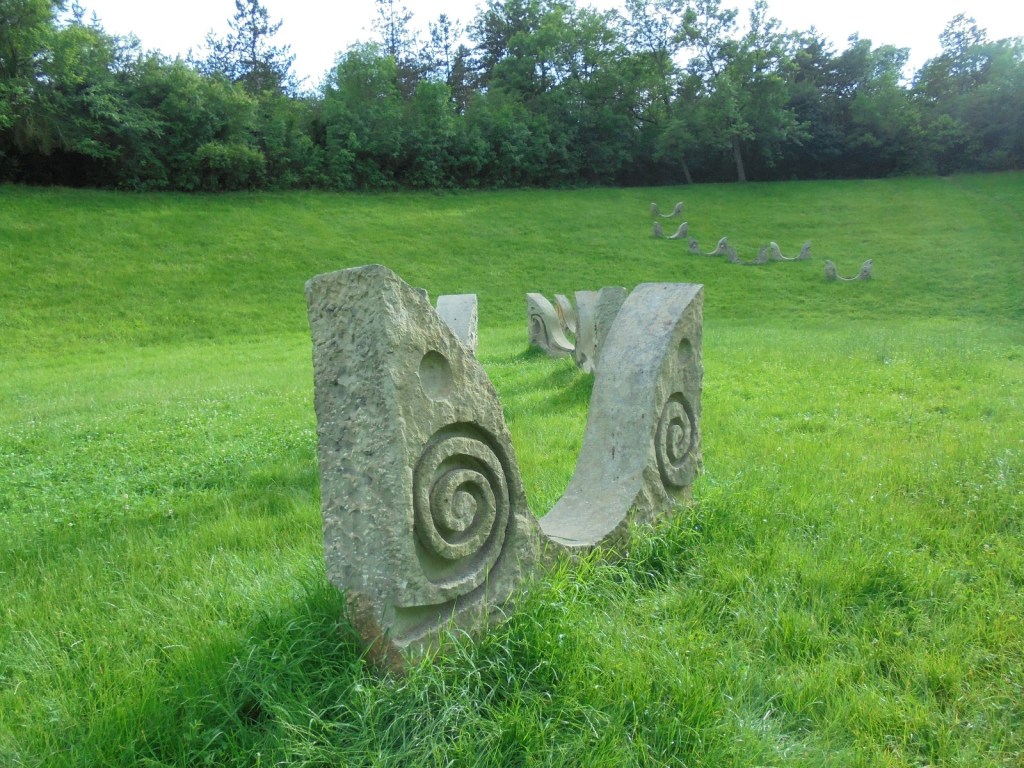
The Symbolic Necropolis of Slobodište (Kruševac), 1961
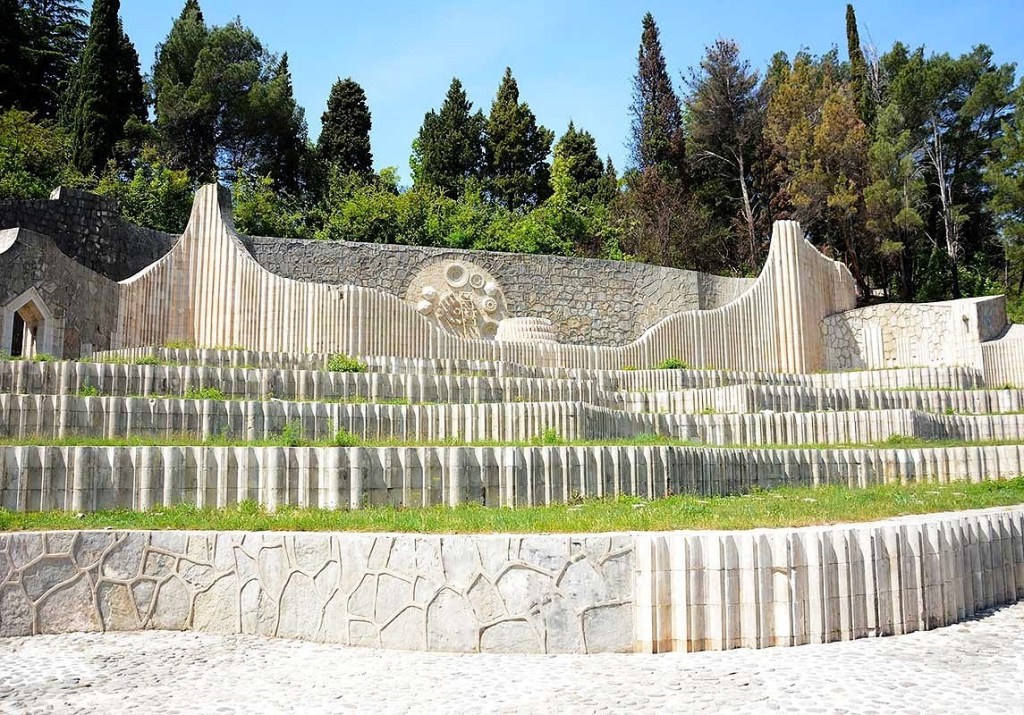
The Monumental Necropolis to the Partisans, Mostar, 1965:
credit Inicijativa Prijatelja Partizanskog Spomen-Groblja Građana Mostara
Still on the subject of the “space of the city”, Bogdan Bogdanović is also the inspiration, promoter, and founder of the Rural School of Philosophy of Architecture in Mali Popović, near Belgrade. The New School’s core principles reflected an effort to strengthen the profession by rethinking the human and social environment, introducing teamwork and interdisciplinary collaboration, especially in the humanities and social sciences. The interdisciplinary classes were conducted in collaboration with faculty and students from other faculties, as well as with experts from non-academic fields. One of the main goals was to increase faculty dedication and establish a more direct relationship between faculty and students. Each student had their own fixed space in the classroom, and faculty were required to travel to the student’s workplace” (Ljubica Slavković 2015, link).
As Bogdan Bogdanović himself stated in an interview with Samuel Abrahám and Miroslav Marcelli, «in our field, the term ‘urbanology’ is not generally accepted. Only the term ‘urban planning’ is used. The situation was the same at the University of Belgrade, and when I became a professor, I began to reflect on what I should and wanted to teach. I was part of the Department of Urban Planning. ‘Urbanology’ didn’t exist before. I defined it as a kind of philosophy of the city. ‘Urbanology’, that is, as a broad platform on which the city can be freely considered, free from market pressures and the different pressures that practical urban planning brings with it. Practical urban planning, especially after the changes that have taken place in our countries, has become the untouchable domain of the mafia». (Bogdan Bogdanović, Samuel Abrahám, Miroslav Marcelli 2014, link).
This vision extends prospectively into his monumental sculpture. «Most of my monuments are dedicated to the victims of fascism, to the partisan movements. They are monuments dedicated to suffering; they are never triumphalist and have no victorious character. They are all linked to the enigma of life and death and the complexity of our feelings in the face of historical events. Later I discovered something in them that I don’t easily admit even to myself: it’s as if they anticipate the present. They commemorated the past tragedy with the premonition that it might happen again» (Bogdan Bogdanović 1992, link).
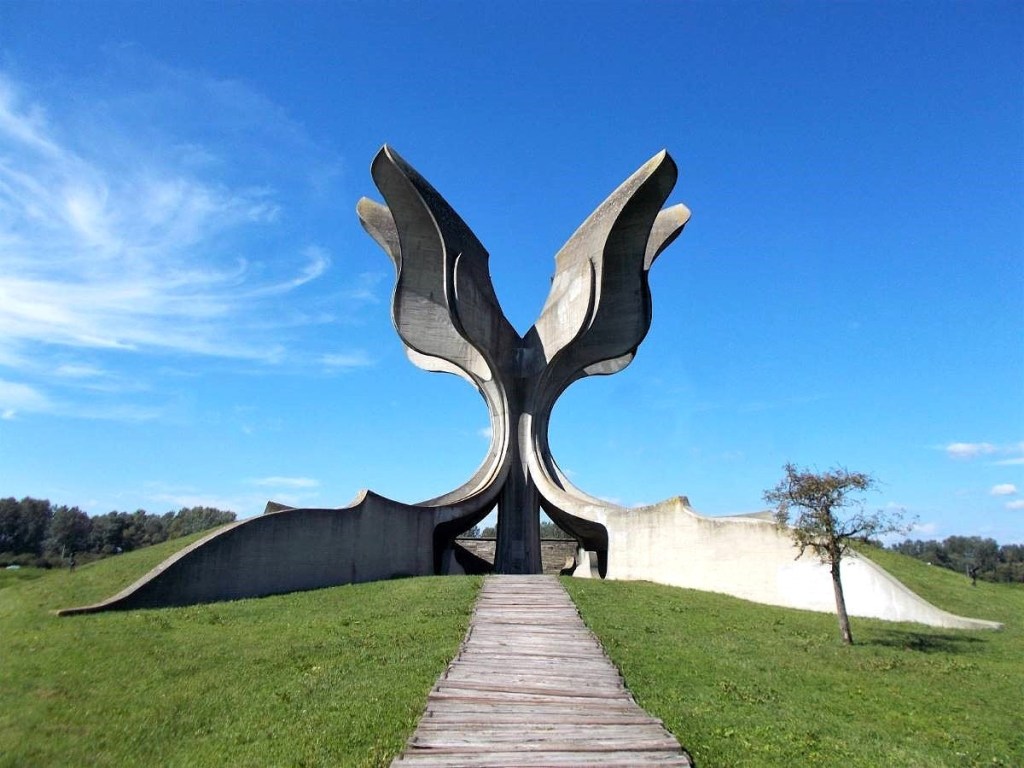
The Monument to the Victims of the Jasenovac Concentration Camp (The Stone Flower), Jasenovac, 1966
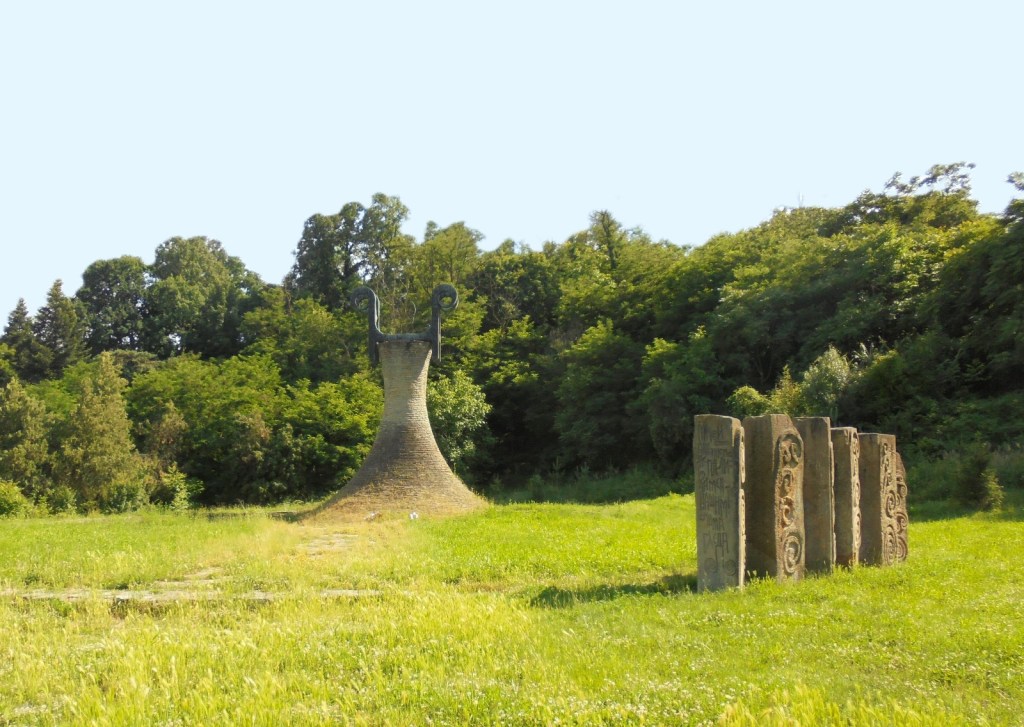
The Memorial Cemetery, Leskovac, 1971
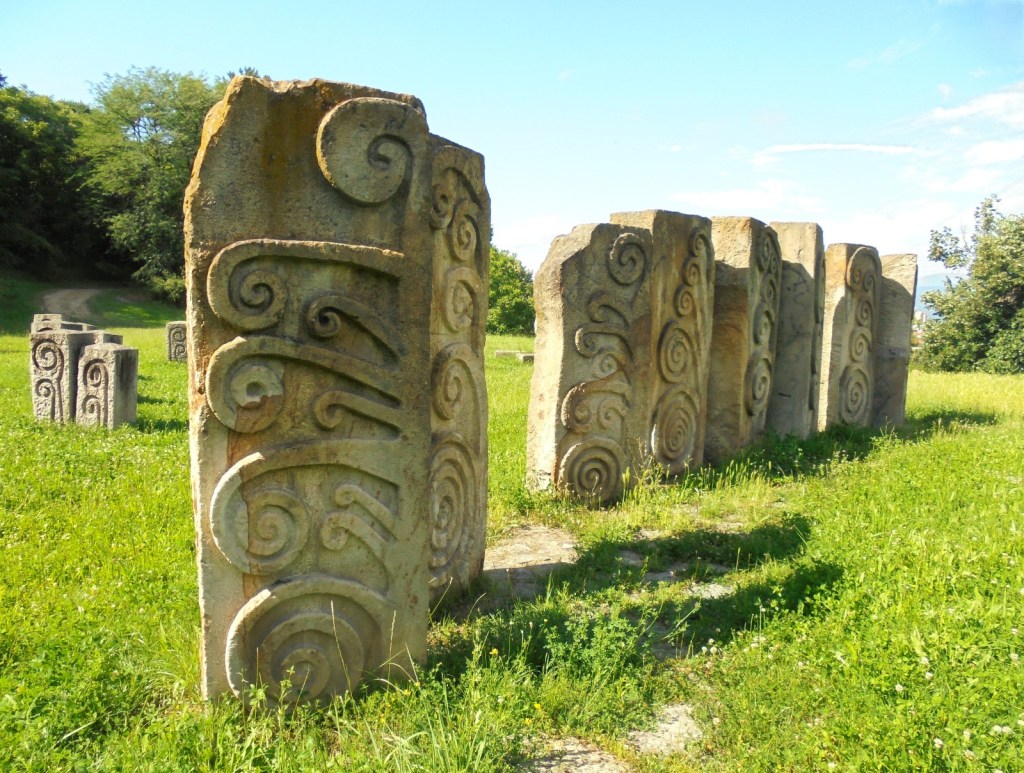
The Memorial Cemetery, Leskovac, 1971
For Bogdan Bogdanović, who has always been active against war and for peace, «the total erasure of every vestige of the adversary’s historical memory is a fundamental component of the war in Yugoslavia. “The new Huns” – as he calls them – attacked the cities because they symbolized the multiethnic coexistence the new nationalisms deny. The main target of this new barbarity could only be Sarajevo, a cosmopolitan city par excellence. “If we accept the principle of dividing cities according to fictitious units – ethnic, religious, linguistic – we will pay terrible consequences”, explained Bogdan Bogdanović during a meeting in Berlin, on the occasion of the presentation of his book “Die Architektur der Erinnerung” (The Architecture of Memory): “No European city is pure”» (Sandro Orlando 1995, link).
«Bogdanović’s approach», observes Emanuele Morezzi, «defined by the architect himself as deliberately surrealist, consistent with his background, aims to develop a free language that cannot be reduced to the mere dramatization of historical events, but is oriented toward placing the citizen at the centre of its attention, understood in their most universal dimension as a human being (without specifics of nationality, ethnicity, religion, origin, or political affiliation) in an attempt to connect them directly to memory and monument.
«Bogdanović’s memorials are therefore architectural experiences of traumatic memory, for understanding the universal meaning of the past. The morphological and symbolic choices recall primitivist forms and references to prehistoric, Etruscan, and Babylonian cultures, in an attempt to search for figures that could truly be considered universal, placed in dialogue with recurring architectural elements such as gates, passages, and terraces, organized into carefully designed visitor itineraries» (Emanuele Morezzi 2025, link).
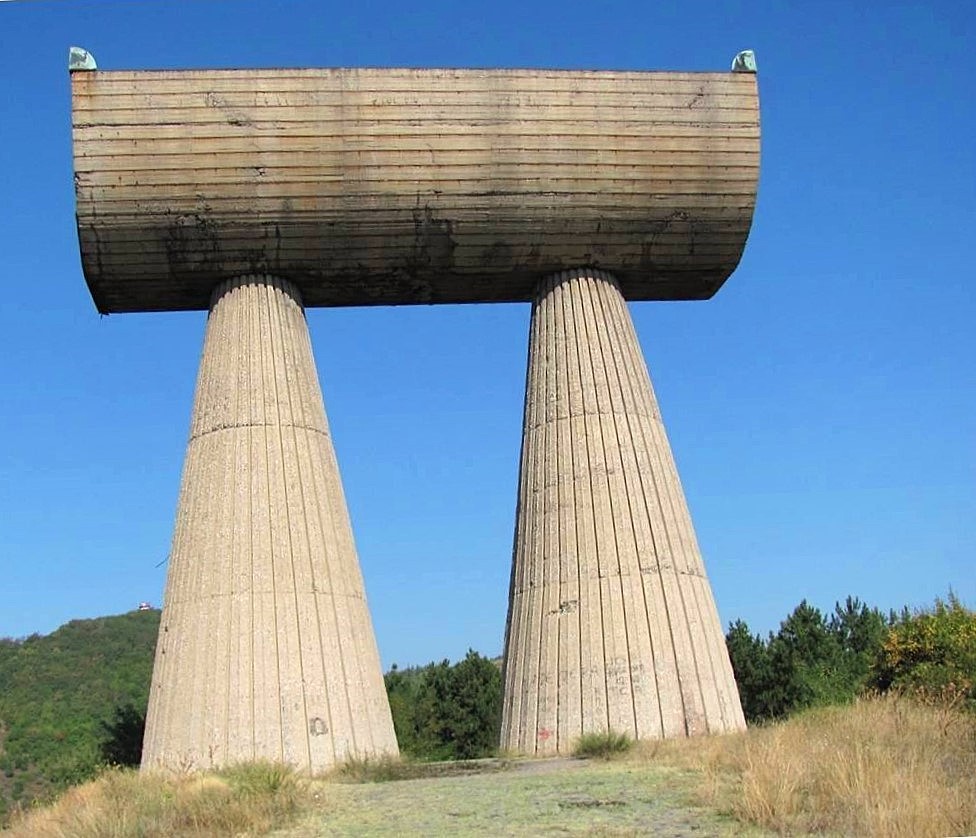
The Shrine of the Revolution dedicated to Serbian and Albanian Partisan Miners, Kosovska Mitrovica, 1973
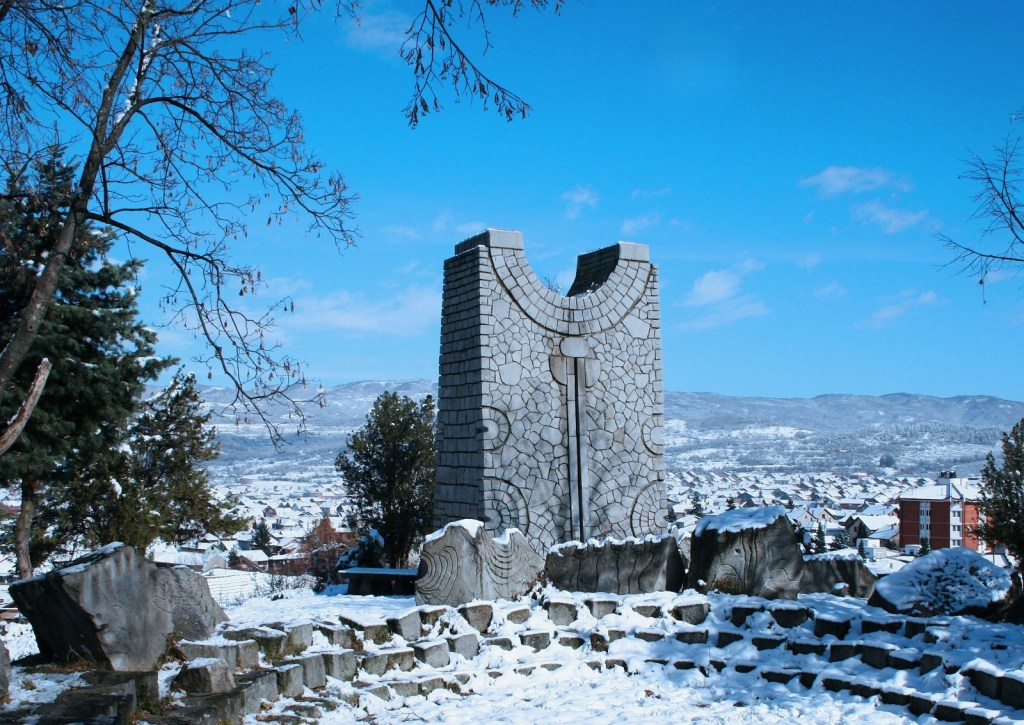
The Shrine to the Freedom Fighters, Vlasotince, 1975:
credit VI, commons.wikimedia.org/w/index.php?curid=7264419, CC BY-SA 3.0
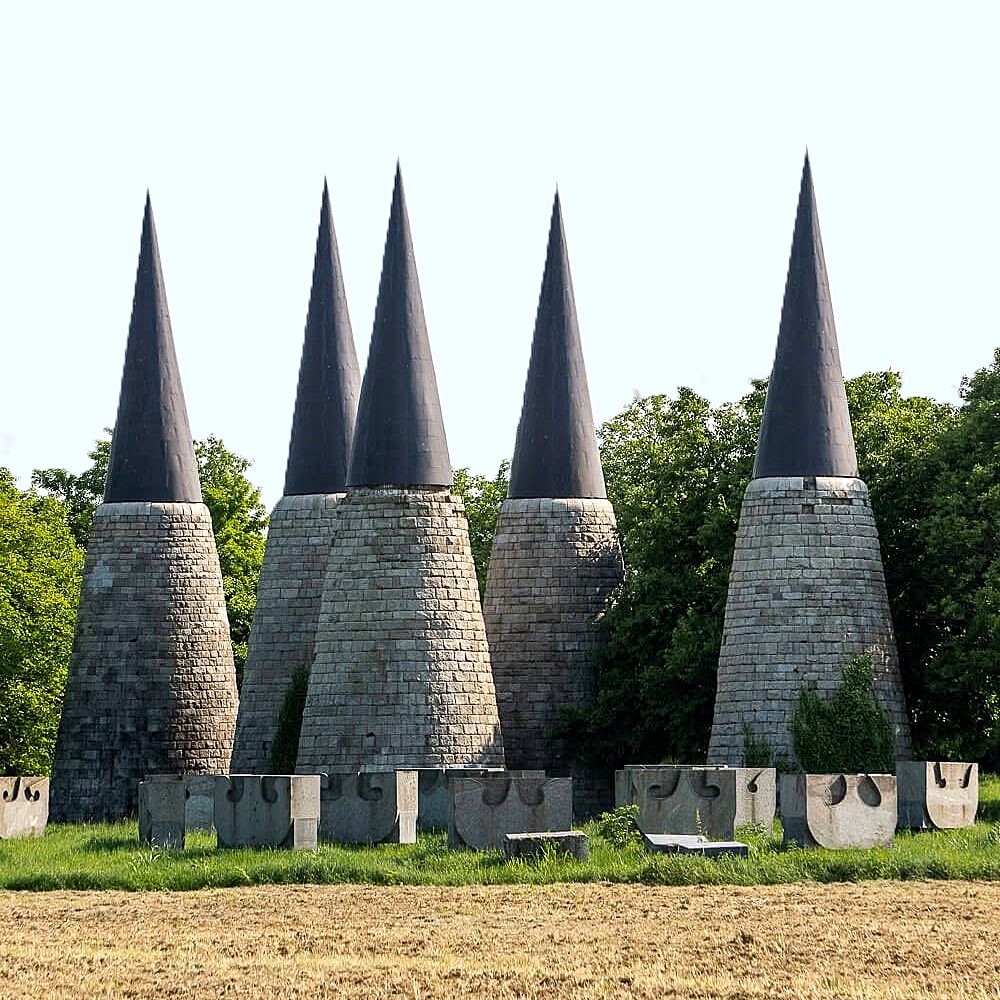
The Dudik Memorial Park, Vukovar, 1980
The list of awards he has received is therefore remarkable. He was awarded the October Prize in 1960 and 1966, the Republican Prize and the Federal Prize of the newspaper “Borba” in 1965, the “7 July” Prize (in observance of the memorial date of July 7, Day of the Serbian People’s Uprising, “Dan ustanka naroda Srbije”, which commemorated the beginning of the armed struggle against the Nazis and Fascists in 1941) in 1976, the Grand Prize for Architecture and the Piranesi Prize in 1989, the Herder Prize in 1997, the Austrian Cross of Honor for Science and Art in 2002, and the Gold Medal of the City of Vienna in 2003.
Among his monuments, his greatest masterpieces are undoubtedly:
• The Memorial to the Jewish Victims of Fascism, Belgrade, 1952;
• The Memorial Necropolis to the Victims of Fascism, Sremska Mitrovica, 1960;
• The Partisan Necropolis (Mound of the Unbeaten), Prilep, 1961;
• The Symbolic Necropolis of Slobodište (Kruševac), 1961;
• The Monumental Necropolis to the Partisans, Mostar, 1965;
• The Monument to the Victims of the Jasenovac Concentration Camp (The Stone Flower), Jasenovac, 1966;
• The Memorial Cemetery, Leskovac, 1971;
• The Shrine of the Revolution to Serb and Albanian Partisan Miners, K. Mitrovica, 1973;
• The Shrine to the Freedom Fighters, Vlasotince, 1975;
• The Dudik Memorial Park, Vukovar, 1980.
For the purposes of the action research developed by H.E.R.M.E.S. project (Heritage-based Education and Research Measures for Empowerment and Sharing) for Civil Peace Corps, starting from the places of culture and memory for peace, these are essential references, vehicles of a non-abstract narrative oriented towards memory, coexistence, and peace.

